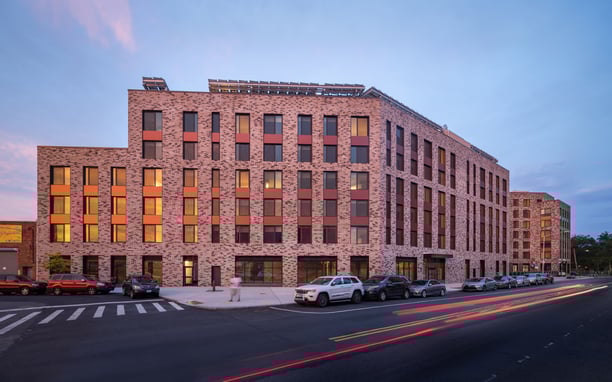
Masonry Details for High-Performance Envelopes: Multi-Family, Commercial, and Institutional Passive Building Case Studies
Tuesday, August 11, 2026 | 12-1 p.m. Eastern Time
1 LU/HSW
Learning Objectives:
- Describe the Phius Passive Building Standard and its integration into local building codes, including Massachusetts’ Opt-in Stretch Energy Code.
- Explain best practices for integrating masonry with continuous insulation and air barriers to support high-performance passive building envelopes.
- Identify common sources of thermal bridging and detail masonry assemblies that reduce heat loss and enhance occupant comfort.
- Discuss how interior and exterior masonry applications contribute to energy efficiency, thermal stability, and overall building durability.
About the Speaker
Katrin Klingenberg
Co-Founder & Co-Executive Director, Phius
.jpg?width=300&height=302&name=Untitled%20design%20(6).jpg)
Katrin Klingenberg is a visionary who, over the past 20 years, has driven adoption and development of passive building and zero energy standards. Passive building methodology originated in the US and Canada in the ‘70s, enhanced in Germany in the ’90s. She reinvigorated it in 2003 when she designed and completed the first home to meet passive house standards in the US. Her home sparked considerable interest and she founded the non-profit organization Phius (Passive House Institute US) dedicated to making passive building best practice. She developed and delivered building-science based training in how to design and build energy efficient, zero energy buildings. She has collaborated with federal and state governments' agencies to tailor the Phius Standard for ASHRAE's global climate zones—such cost-optimized passive building has driven widespread adoption. She has consulted on projects nationally and internationally. Phius updated its standard in 2021 to meet stringent efficiency and carbon neutrality goals, and to make buildings the building block of the 21st century electrical grid: resilient, digitized, distributed, interactive.
Ms. Klingenberg has written numerous magazine articles and made several book contributions. She has presented nationally and internationally on the topic of passive building science. Most recent publications: Chapter 14 Stranded Carbon: Approach every project as though PHIUS+, the building energy code of the future, were in effect today” in: Sustainable Nation – Urban Design Patterns for the Future, Douglas Farr, Wiley 2018; Chapter Passive Building and Bioclimatic Architecture in "Handbook of Energy Efficiency in Buildings", Elsevier 2018; Chapter Passive House in "Encyclopedia of Sustainability Science and Technology", Springer 2012, updated in 2018; Zero Energy & Carbon Buildings Based on Climate Specific Passive Building Standards for North America, Journal of Building Physics, SAGE Publications 2016; the U.S. Department of Energy, Building Technologies Office, Building America Program Report Climate-Specific Passive Building Standards, NREL 2015.
In 2015, she won the Woman in Sustainability Leadership Award (WSLA2015). In 2017, she was one of 12 women entrepreneurs selected from around the world for the Global Ambassador Program of Vital Voices. She has been a Senior Fellow at New Buildings Institute (NBI) since 2020. In 2022, she won the Professional Leadership Award of the North Eastern Sustainable Energy Association (NESEA) and received the Distinguished Alumni Award of the Estopinal College of Architecture and Planning.