February is Black History Month, and we’re celebrating the talented craftworkers who have made strong careers in the trowel trades!
Here are their stories.
Isaiah Rutherford, BAC Local 13 Nevada (Mountain West ADC)
When Isaiah Rutherford began working in the trowel trades 25 years ago, he had no idea he’d uncover his hidden passion for stone.
.jpg?width=301&height=402&name=IsaiahRutherford%20(1).jpg) “There are so many different varieties, different kinds, with different looks and veins and flakes and patterns,” said Rutherford, a member of the International Union of Bricklayers and Allied Craftworkers since 2001. “With stone, you have to be careful with it, it’s fragile, but it’s strong. Stone will never go out of style and it will last forever.”
“There are so many different varieties, different kinds, with different looks and veins and flakes and patterns,” said Rutherford, a member of the International Union of Bricklayers and Allied Craftworkers since 2001. “With stone, you have to be careful with it, it’s fragile, but it’s strong. Stone will never go out of style and it will last forever.”
He got into the trades after a friend’s father, who was a stone mason and the president of the local, encouraged him.
“As I got into it, it really grew on me,” Rutherford said.
Favorite projects he’s worked on include City Center on the Las Vegas Strip and Durango Station, on the other side of Las Vegas, because of all the stonework.
Rutherford is in the process of getting his journeyman tile setter card and advises other aspiring tradespeople to learn as much about their trade as they can.
“Put out the best product that you can and be mindful of your body,” he said. “I’ve been able to use the trades to not just grow as a person, but as a businessperson. I’ve learned about products and customer service and how to carry myself in a professional situation.”
Reynold Ramsey Jr., BAC Local 1 Connecticut
Reynold Ramsey Jr., a brick mason since 2015, always knew he was interested in hands-on work.
“I went to college, but I’m not really a desk person,” he said.
While his grandfather and uncles worked in carpentry, Ramsey said he was more drawn to masonry because he likes being able to see the tangible result of his hard work.
“Being able to point to something and say I built that, I did that, like when I worked on the old State House downtown in Hartford,” he said. “I’ve also work
ed on a lot of schools and that’s rewarding, a good way to give back to the community.”
Reynolds took part in the International Masonry Institute’s Aspiring Contractor Development Program this year, working toward his goal of becoming a top minority-owned business.
“I want to be not only a contractor, but a role model,” he said. “I want to be able to go into the schools and talk to the youth about getting into the trades and just be a positive influence.”
You’ll have good days and bad days on the job, Ramsey said. The important thing is to stay humble.
“And focus on your family,” he said. “Make your decisions based on how they will affect your family.”
LaDarius Moye, BAC Local 8 Southeast
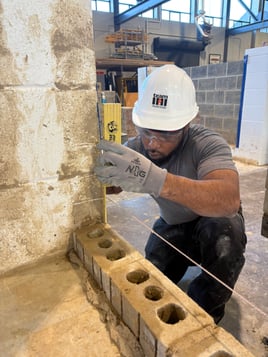
“It feels natural, like this is what I’m supposed to be doing,” said Moye. “I have a carpentry background, so I’m taking one skill set and applying it to the next.”
An aspiring journeyman, Moye said he loves working with his hands and seeing the tangible results of his work. The training he's received is helping him build confidence on the job.
“You shouldn’t start your career without it. It’s preparing me to be ready to work in the field,” he said.
Anthony Cunningham, BAC Local 1 Pennsylvania and Delaware
When Anthony Cunningham learned about a program that would allow him to train for a career in masonry at the historic Eastern State Penitentiar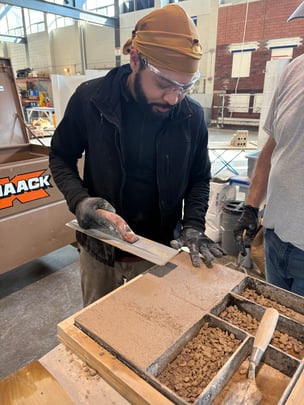 y, he was intrigued.
At 31 years old, he’d dabbled in several different careers but hadn’t quite found the right one. Enter Rebuild Philadelphia, the city of Philadelphia’s initiative to repair public structures.
Rebuild also helps residents pursue construction careers through workforce development programs, including one at Eastern State.
Anthony, now a first-year apprentice, spent 6 weeks working on the National Historic Landmark, fixing cell block walls that were dilapidated, resetting stones, and repairing the structure’s mortar and joints.
“There is a satisfaction about it,” said Cunningham as he mixed concrete as part of IMI’s Concrete Repair Certificate Program. “It reduces stress. It’s like playing in the dirt as a kid.”
For Cunningham, working on historic structures is "a way to be able to contribute to society as a whole. If we’re not here to restore it, it’s not going to be here in the future," he said.